
The Science Behind Hyperbaric Oxygen Therapy
Understanding the biology behind every breath.
Hyperbaric Oxygen Therapy combines established principles of physics with human physiology to temporarily increase the amount of oxygen dissolved within the blood plasma. This enhanced oxygen availability supports a wide range of biological processes involved in healing, recovery and cellular function.
Explore the scientific foundations of HBOT, from Boyle's, Henry's and Dalton's Laws to oxygen transport, mitochondrial activity, angiogenesis and stem cell mobilisation, to better understand how pressure influences the body's response to treatment.

THE LAWS OF PHYSICS
The scientific principles that make Hyperbaric Oxygen Therapy possible
BOYLE'S LAW
As pressure increases,
gas volume decreases.
Boyle's Law explains why the volume of trapped gases changes as pressure increases. During compression, the air spaces within the ears, sinuses and lungs become smaller, which is why pressure equalisation is an important part of every HBOT session.
HENRY'S LAW
As pressure increases, more gas dissolves into a liquid.
Henry's Law forms the foundation of Hyperbaric Oxygen Therapy. By increasing atmospheric pressure while breathing oxygen, substantially more oxygen dissolves directly into the blood plasma, allowing it to reach tissues beyond the oxygen carried by haemoglobin alone.
DALTON'S LAW
Total pressure equals the sum of each individual gas.
Dalton's Law explains partial pressure. As chamber pressure increases, so does the partial pressure of oxygen, increasing the driving force that moves oxygen from the lungs into the bloodstream and ultimately into the body's tissues.
OXYGEN TRANSPORT
More Oxygen.
More Possibilities.
Hyperbaric Oxygen Therapy doesn't increase the amount of oxygen your red blood cells can carry; they're already almost full. Instead, pressure allows significantly more oxygen to dissolve directly into your blood plasma, enabling oxygen to reach tissues that would otherwise receive much less.
HAEMOGLOBIN-BOUND OXYGEN
The oxygen carried inside red blood cells. Under normal conditions, this supplies the vast majority of your body's oxygen.
DISSOLVED OXYGEN IN PLASMA
Free oxygen dissolved directly within the blood plasma. This increases substantially under hyperbaric pressure.
NORMAL CONDITIONS
Most oxygen travels inside red blood cells.
UNDER HBOT (2.0 ATA)
Pressure dramatically increases dissolved oxygen.
.png)
Approximately 0.3 ml of oxygen per 100 ml of blood is dissolved directly in plasma.
Around 6–7 ml of oxygen per 100 ml of blood can dissolve directly into the plasma; up to around 20 times more than under normal conditions.
CELLULAR & MOLECULAR MECHANISMS
Increased oxygen availability triggers a wide range
.png)
MITOCHONDRIAL FUNCTION
Increased oxygen availability supports mitochondrial activity and cellular energy production.
.png)
REDUCED INFLAMMATION
HBOT can influence inflammatory signalling, helping regulate excessive inflammatory responses.
.png)
STEM CELL MOBILISATION
Repeated hyperbaric exposure has been associated with increased mobilisation of circulating stem and progenitor cells.
.png)
ANGIOGENESIS
Hyperoxia can stimulate signalling involved in the development of new blood vessels and improved tissue perfusion.
.png)
COLLAGEN SYNTHESIS
Oxygen is essential for collagen formation, supporting connective tissue repair and wound healing processes.
.png)
IMMUNE MODULATION
HBOT can influence immune cell activity and inflammatory signalling, supporting a regulated immune response.
WHY PRESSURE MATTERS
Personalised pressure.
Personalised results.
Hyperbaric Oxygen Therapy is not a one-size-fits-all treatment. Different treatment pressures may support different physiological responses, which is why treatment recommendations should always be guided by both the available evidence and the individual.
At Renume, we consider your goals, medical history, comfort and the relevant treatment protocols when recommending pressure and session frequency.
The most appropriate pressure isn't always the highest. It's the one that's right for you.
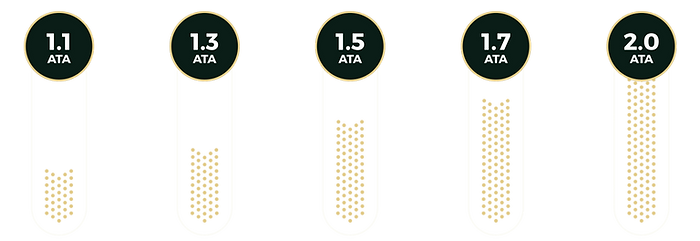.png)
.png)
As treatment pressure increases, so does the amount of oxygen dissolved into the blood plasma. However, HBOT isn't simply a case of "more is better". Different treatment pressures are associated with different physiological responses, which is why a range of evidence-based treatment protocols exist.